Showing posts with label Chemistry. Show all posts
Showing posts with label Chemistry. Show all posts
Friday, March 9, 2012
 |
| p- block |
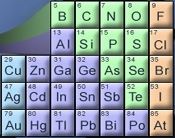
In p- block elements the last electron enters the outermost p orbital. As we know that the number if p- orbitals is three and therefore the maximum no of electrons that can be accommodated in a set of p orbitals is six. Consequently there are six groups of p- block elements in the periodic table numbering from 13 to 18. Boron, carbon, nitrogen, oxygen, fluorine and helium heads the groups. Their valence shell electron configuration is ns(2) np(1-6) except for helium.
 |
| Elements in p- block |
The inner core of the electronic configuration may, however, differ. The difference in the inner core of the elements greatly influences their physical properties(such as atomic and ionic radii, ionization enthalpy,etc) as well as chemical properties. A lot of variation in properties of elements in a group of p- block is observed. The maximum oxidation state shown by a p- block element is equal to the total number of the valence electrons. Clearly, the number of possible oxidation states increases towards the right of the periodic table. In addition to this so called group oxidation state, p- block elements may show other oxidation states which normally differ from the total number of valence electrons by unit of two. in Boron, Carbon and Nitrogen families the group oxidation state is most stable for the lighter elements in the group.
Friday, March 9, 2012 0
Tuesday, February 21, 2012

Chemistry plays an important role in our everyday life. Since the beginning of this branch of science, it has been in the service of mankind. Our daily needs of food, clothing, shelter, potable water, medicines, etc. are in one or other manner connected with chemical compound, processes and principles.
We always owe a debt to chemists for their important contributions for giving us life saving drugs, synthetic fibers, synthetic detergents, variety of cosmetics, preservatives for our food, fertilizers, pesticides, paper, glass, strength materials, plastics, beautiful paints,etc. There is no aspect of our life that is not affected by the developments in chemistry. In fact, chemistry is the single branch of science which profoundly influences the existence of human beings and the habitat. Thus, the mankind owes much to chemistry because it has improved the quality of life.
The chemical substances used for treatment of diseases and for reducing suffering from pain are called medicines or drugs. The term chemotherapy is used for the science in which suitable chemicals are used for the treatment of diseases. These chemicals have specific effect for destroying the invading organisms without injuring the cells of the body. In the ancient practices of treatment of diseases like Ayurvedic, the Unani systems or the modern allopathic system, the drugs used are chemical compounds of natural or synthetic origin.
Tuesday, February 21, 2012 0
Subscribe to:
Posts (Atom)


